How to grind from Bronze to Unreal in Fortnite Reload without losing your mind
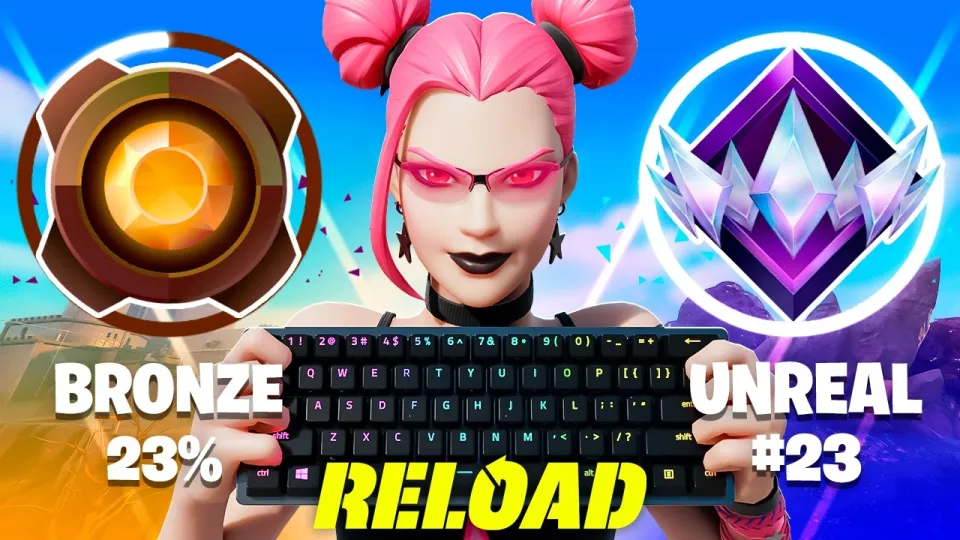
Video: BRONZE To UNREAL Ranked Speedrun In Fortnite Reload!
You can order the same kind of articles for your own video to boost it on YouTube and Google. Just message the Telegram bot @sat_sit_bot. It writes articles around your video, embeds the video and publishes them on popular niche websites (no ads). Try it free: 50 articles on us.
· based on the channel HaloBT
Key takeaways
- Fortnite Reload is a faster, smaller-squad mode: shorter matches, quicker respawns, and tighter circles than standard Battle Royale.
- The ranked ladder runs Bronze, Silver, Gold, Platinum, Diamond, Elite, Champion, and Unreal — Unreal sits at the very top.
- HaloBT's speedrun video covers the full Bronze-to-Unreal push in Fortnite Reload, with the Gold bracket called out as the hardest stretch.
- Reload rewards consistent placement plus eliminations, so survival alone will not carry you past Platinum.
- Aim/edit practice maps and a fixed drop plan matter more than raw mechanical flash during a long climb.
Fortnite Reload is a condensed Battle Royale mode where the fastest route from Bronze to Unreal is a repeatable routine: one safe drop, a fast loot path, early eliminations for placement points, and a hard stop on fights you cannot win. HaloBT's Bronze-to-Unreal speedrun shows the whole ladder in one sitting, and the pattern that emerges is less about flashy mechanics and more about removing randomness from every match. If you want the same practice tools the run leans on, HaloBT's Fortnite creator page (maps and practice codes from MoreHaloBT) is the place to start.
Reload compresses the usual Battle Royale loop. Squads are smaller, the map is tighter, respawns exist, and matches end faster — which means you get more ranked games per hour than in standard BR. That density is exactly why a speedrun is possible at all.
What Fortnite Reload ranked actually rewards
Fortnite Reload ranked scoring is built on two pillars: how long your team survives and how many eliminations you contribute, with placement weighted heavily at the top of the ladder. That combination punishes two opposite mistakes — hiding all game and fighting everything that moves.
- Placement first, kills second. A quiet top-five finish almost always beats a chaotic early exit with three eliminations.
- Team survival counts. In Reload, your squad's result is your result, so reviving and rebooting is scoring, not charity.
- Consistency compounds. Ten steady matches move you further than one highlight game followed by five instant deaths.
- Bracket difficulty shifts. Bronze and Silver forgive mistakes; Gold, Platinum, and Diamond start punishing them; Elite and Champion demand near-zero unforced errors.
Because matches are short, the ladder moves faster than in standard ranked — but it also means a bad streak can erase an evening's progress in under an hour.
The Bronze-to-Gold phase is about volume, not cleverness
The first stretch of any Bronze to Unreal ranked speedrun is a volume game: play clean, play fast, and do not overthink opponents who are still learning the map. In Bronze and Silver, most lobbies lose themselves — players push without cover, land in contested POIs with no plan, and fight in the open.
What works here:
- Land somewhere you know every chest and door of, and land there every single game.
- Take the first fight only when you have a weapon advantage or a third-party angle.
- Rotate early rather than late; in Reload the circle closes quickly and late rotations get pinched.
- Use respawns aggressively but not suicidally — a respawned teammate with no loot is a liability for the next 30 seconds.
HaloBT's run treats this phase as a warm-up. The real filter is ahead.
Why Gold is the real wall in a Bronze to Unreal speedrun
Gold is where the ranked ladder stops rewarding good habits alone and starts demanding that you beat players who also have good habits. Viewers of HaloBT's run described the Gold bracket as feeling like a tournament final, and that reaction tracks: Gold lobbies mix genuinely improving players with smurfs and returning veterans, so match quality swings wildly from game to game.
Three things break the wall:
- Stop taking 50/50 fights. In Gold, the player who initiates a coin-flip fight usually loses it to a third party.
- Learn one build-and-edit retake. You do not need a full mechanical toolkit — one reliable piece control sequence covers most situations.
- Play the edge of the circle. Zone-edge rotations give you information, back protection, and easier third parties.
If you are stuck in Gold for more than a dozen matches, the problem is almost never aim. It is decision-making under pressure.
Duo fills and solo queues demand different habits
Queue format changes the climb more than most players expect, and Fortnite Reload supports both solo and duo-fill approaches. In duo fills you inherit a random partner's habits, so your job shifts from pure self-improvement to damage control.
- Duo fills: communicate your drop immediately, share loot without arguing, and treat the partner as a resource. If they push badly, follow at distance rather than abandoning them — a two-player fight is still better than two one-player fights.
- Solo queue: you are the whole team. Prioritize survival, take only fights you can reset from, and accept that some games are unwinnable through no fault of yours.
A solo unranked-to-Unreal push is slower per game but far more predictable, because nothing depends on a stranger's mood.
Loadout and mechanics that carry the climb
A ranked climb in Fortnite Reload is won with a boring, repeatable loadout rather than a highlight-reel one. The core is simple: one close-range weapon, one mid-range weapon, heals, and mobility or utility.
- Close range: a shotgun you have actually practiced with, not the one with the best stats on paper.
- Mid range: an assault rifle or SMG for chip damage and finishing cracked opponents.
- Heals: at least two slots' worth of healing; Reload's pace means you will use them every game.
- Utility: mobility items decide rotations, and rotations decide placement.
On mechanics, controller players should not try to mirror keyboard players' edit speed. Controller aim assist rewards tracking and close-range consistency, so lean into that: hold angles, force close fights, and let the opponent come to you. Keyboard players should spend ten minutes a day in an aim-and-edit practice map before queueing — the improvement curve flattens fast otherwise, and a fixed warm-up routine is the simplest way to restart it.
Mindset rules that keep a speedrun alive
Ranked Fortnite is a stamina test disguised as a shooter, and the players who reach Unreal are usually the ones who quit while ahead. Set a loss limit — two or three bad games in a row and you stop — and protect your rank instead of chasing it.
Also worth internalizing:
- Losing points in Diamond is not a catastrophe; tilt-queueing after a loss is.
- Review one death per session and name the actual mistake, not "bad luck."
- Accept that a percentage of games are decided by loot and third parties before you fire a shot.
HaloBT's run is a demonstration of exactly this: fast games, clean resets, no dwelling on individual losses.
Useful links from the video
All of these come straight from HaloBT's channel and description:
- Practice maps and Fortnite creator profile: https://www.fortnite.com/@MoreHaloBT
- Community Discord: https://discord.com/invite/halobt
- Twitch streams: https://www.twitch.tv/halobt
- Twitter: https://twitter.com/halobombtrooper
- Instagram: https://www.instagram.com/therealhalobt
- The speedrun video itself: https://www.youtube.com/watch?v=1ZCPZi14gUc
Final word on the Fortnite Reload climb
The Bronze-to-Unreal grind in Fortnite Reload is less about talent and more about repetition: one drop, one loadout, one decision rule per rank bracket. Gold is the honest test, Diamond is where discipline pays, and Unreal rewards the players who stop playing when they are tilted. HaloBT's speedrun is worth watching not for the highlight kills but for how little randomness the run allows itself. If you want to follow the same path, grab the practice maps at MoreHaloBT on fortnite.com and start queueing with a plan instead of a hope.
Questions & answers
How long does it take to go from Bronze to Unreal in Fortnite Reload?
There is no fixed number, but Reload's short matches mean more ranked games per hour than standard Battle Royale, so the climb is faster in wall-clock time. A skilled player grinding consistently can move several brackets in a single long session, while an average player should expect many evenings of play. The bottleneck is almost always Gold and Diamond, not the early ranks.
Is it easier to reach Unreal in solo queue or duo fills?
Solo queue is more predictable because nothing depends on a random partner, but duo fills can be faster when the partner cooperates. In fills, communicate your drop immediately and treat the partner as a resource rather than a liability. If you care about consistency over speed, solo is the safer route.
Why do I get stuck in Gold every season?
Gold lobbies mix improving players with smurfs and returning veterans, so match quality is inconsistent and coin-flip fights get punished by third parties. The fix is usually decision-making rather than aim: stop taking 50/50 fights, learn one reliable retake, and play the zone edge for information and back protection.
Do I need advanced building to climb in Fortnite Reload ranked?
No. One practiced piece-control sequence covers most situations, and controller players in particular benefit more from holding angles and forcing close-range fights than from chasing edit speed. Ten minutes in an aim-and-edit practice map before queueing does more for most players than hours of free-building.
Source: BRONZE To UNREAL Ranked Speedrun In Fortnite Reload! · Markdown version